RSS
G20 reaches no consensus
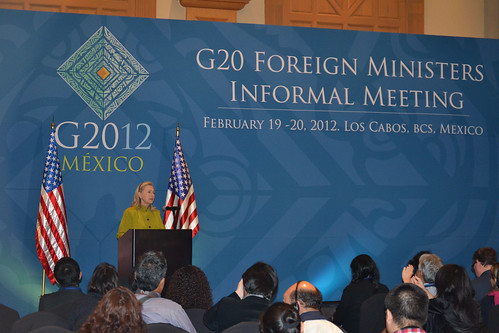 The G20 has not come up with a consensus on Europe’s Debt Crisis at its meeting in Mexico City.
According to the CBC, the representatives from the world’s leading economies have been working on a second global rescue package in order to stop the crisis from spreading.
It could be worth about 2 trillion US dollars.
The decision about bailout money has been postponed.
Head of the Organization of Economic Cooperation and Development (OECD) Angel Gurria said 1,5 trillion US dollars would be needed for adequate stabilization.
Germany’s parliament will vote on Monday on whether they will approve the bailout package already agreed on for Greece.
Canada and the US said they don’t want to put any more money into this unless Germany does it first.
A final decision about Europe’s bailout will be made at the G20’s next meeting in April.
February 24, 2012
Read by Shaun Malley
Produced by Erica Bridgeman
Stories written by Tara Brockwell, Katie McGroarty, Judy-Ann Mitchel-Turgeon and Danny Aubry
Students amass another anti-tuition protest
 Student protesters blocking Jacques Cartier Bridge at rush hour yesterday were shut down by police.
According to the Montreal Gazette three hundred students were blocking a main bridge connecting Montreal to the South Shore for almost an hour yesterday.
Montreal Police used pepper spray to disperse the crowd after warnings to leave weren’t observed. One arrest was confirmed.
Students were protesting the almost two thousand dollar increase in tuition fees expected to take place over the next five years.
The National Assembly will be debating a non-confidence motion on the proposed hikes this Tuesday.
Photo by Joel Balsam on November 10, 2011
French journalist Edith Bouvier asked to leave Syria.
 The French journalist Edith Bouvier has asked to leave Syria as soon as possible stating that she needs an operation.
According to BBC News Bouvier was injured on Wednesday in the Baba Amr suburb where two other French journalists were killed.
Her thigh bone is broken in two separate areas.
She appreciates what the Syrian doctors have done, but believes their medical technology lacks what`s needed to treat her injury.
Truth and Reconciliation Commission's interim report leaked
The Truth and Reconciliation Commission’s interim report leaked on Thursday, a day before the actual report was to be released in Vancouver.
It is composed of 20 recommendations that include some about health, education, and commemoration, among others.
The report calls on material about residential schools in aboriginal communities to be included in the jurisdiction of public schools to inform kids about the history.
It also asks the federal government to implement other coping measures for residential schools survivors across the country.
The first residential schools were opened in the 1840s and the last one was closed in 1996.
This report is released as the commission reaches the half of its five-year mandate.
The commission is set to release its full report when it reaches the end of its mandate, in 2014.
February 23rd, 2012
Read by: Katie McGroarty
Stories by: Katie McGroarty, Dominique Daoust, Esther Viragh and Alexa Fay
Produced by: Carlo Spiridigliozzi
Estimated costs for lawful access bill released
 Bill C-30 now has an estimated price tag.
According to the CBC, the online surveillance bill will cost at least $80 million to implement.
The bill would update Canadian law when it comes to crimes committed online.
It would force online service providers to give costumer information to the police.
The bill will cost $20 million a year for the first four years and $6.7 million a year after that.
It is unclear if those are the only costs associated with the legislation.
Flickr photo by: governmentofalberta
Violence in Syria

 Two Western journalists were killed Wednesday in the Syrian city of Homs during bombings that left approximately sixty dead.
Marie Colvin was a Sunday Times reporter and Remi Ochlik was an award-winning French photographer. They both died when a shell hit the makeshift media center they were working in.
Since the uprising has begun, Western journalists have been denied entry into Syria. But helped by activists, increasingly more journalists have been entering the country undercover.
The Red Cross is presently demanding a daily ceasefire. They want to allow medical supplies in and civilians out, but there is no sign of this being agreed to.
Montreal says no to photo radars
 Municipalities will be allowed to set up more photo radars. Bill fifty-seven will allow more of them in high risk areas like school zones and roadwork areas.
The bill was introduced in the National Assembly on Wednesday by Transport Minister Pierre Moreau. He says the fifteen photo radars already in place in the province have made drivers slow down.
One city that isn’t agreeing with this bill is Montreal. Mayor Gerald Tremblay says they don’t want any since they can’t control extra cash revenue.
Quebec City on the other hand is setting up more photo radars. As long as it is used to promote safer roads, Transport Quebec says the public is supporting this system.
According to an all-party committee, the photo radars are effective in reducing speed and collisions.
Flickr photo by: etgeek (Eric)
This Week in Sports: February 22nd

NHL:
While the Habs flounder down the stretch as they attempt to reach a miraculous playoff spot, reality is starting to set in for Canadiens management. Pierre Gauthier shipped popular defenseman Hal Gill, who is scheduled to become a free agent this summer, to Nashville for Blake Geoffrion, Robert Slaney and a 2nd round pick in this years NHL Draft. The trade has been given a unanimous thumbs up, considering the amount Gauthier got back, not to mention the family ties Geoffrion has to the Habs; he's the son of brief Hab Danny Geoffrion, grandson of the inventor of the slapshot, Bernard "Boom Boom" Geoffrion, and great-grandson of the legendary Howie Morenz (both Geoffrion and Morenz have their numbers retired by the Habs). Geoffrion will provide good size, speed, and grit on the Habs bottom two lines as soon as next year, and if the Habs capitalize on the pick they received, this trade could become a huge win for the Habs.
NBA:
While the Miami Heat seem to always be in the news for various reasons, Lebron James seems to attract the most attention, either by his own accord or simply for being Lebron. Last week, he brought it upon himself by coming out before his team's matchup against his former team, the Cleveland Cavaliers, by saying that it wasn't out of the question that he could one day return to his old stomping grounds. This set off the usual amount of hype and debate among fans and experts alike, and set off the still-hurting Cleveland fanbase, who mercilessly booed James during the Heat-Cavs game the next day... someone should tell Lebron to stop adding fuel to the fire. Karma has already bit his team once, he should focus on playing ball and not worry about something that would probably only be a reality years and years from now.
MLB:
Pitchers and catchers are starting to report around Major League spring training facilities, and perhaps the biggest story of the week was the announcement that much-maligned slugger Manny Ramirez is making a return to the big leagues with the Oakland Athletics after signing a one-year, $500,000 contract earlier in the week. It remains to be seen if Ramirez has anything left to give to a major league team, after coming off a long suspension and a brief retirement. If he pans out, though, the A's add a huge bat that will definitely help them offensively.
-Andrew Maggio co-hosts Game Misconduct every Sunday from 12pm-2pm and runs a dedicated Habs blog that you can check out here
Pages



Staff Login | Advertise | Our Location | RSS | Contact Us
