RSS
Montreal Fringe Matt Enos & The Rivermen Can Make Any Evening Blissful

Sunday evening, at a cosy Petit Campus on Prince Arthur Street, was a band mesmerising their audience with soulful blues and jazz tunes.
Standing front and center engaging with the cheering audience was the band’s lead guitarist and singer Matt Enos. To his right was their bass guitarist Gavin Marshall, and to his left was Ben Brimacombe playing beautifully on the keyboard for Montreal's Fringe. A band playing songs to sway is only incomplete without a drummer; and so behind the three members with his enormous drum set, filling the songs with rhythmic beats and ambient sound bits, was Chris Leger. Together, they are Matt Enos & The Rivermen, for whom you should keep your ears out for.
Matt Enos narrated a story about how he encountered a street that was filled with people getting high. The funny interactions and scenes on this street inspired him to choose Ray Charles’, “Let’s Go Get Stoned” to improvise. Jazz and the blues are considered to be the best music genres to improvise and jam with among other musicians. The band has put this feature to their best use.
Halfway through wonderful improvisations and original compositions by the band, Matt Enos picked up his red shining guitar to play the "Lonesome Child" tune. They rocked the stage with this, garnerning the rowdiest cheers and longest hoots from the crowd.
Over the summer they are playing at different venues. Watch out for updates on their Facebook page for more blissful evenings here.
Hip-Hop for Life: the Music Video Edition

Lately there’s been an effervescence ringing through the city, and my bets are on it being from CJLO celebrating its third Hip-Hop for Life this week! The Afro-American music genre transcends itself into an impetus that sparks social change, awareness and community. In addition to curated shows, playlists, conferences, and workshops all dedicated to celebrating hip-hop’s vast and pervasive influence within art, the media, politics, culture, language, fashion and so much more; the magazine team wants to hop (pun unintended) onto the zeitgeist too and show some love. Without further ado, here are Remi Caron’s top hip-hop music video picks. – Kaitlyn DiBartolo, Magazine Editor
If I were to take on the task at declaring the best movie about hip-hop of all time the title and remaining champion in my book would be F. Gary Gray’s Straight Outta Compton, a biographical portrait of the rap group N.W.A. However, I shouldn’t overlook the performances that rappers bring to the silver screens, including Eminem in 8 Mile or Tupac Shakur in Juice. Sadly we lost Tupac too young to see what he would have become as an actor in his later career, and Eminem’s only other acting credit was a cameo in Funny People where he has an argument with Ray Romano. However, being a fan of music videos as much as I am of film, I have decided to highlight some hip-hop/rap videos that have stuck with me and that you should consider alongside the aforementioned greatest hip-hop movie of all time, and of rappers-turned-actors.
1. N.W.A. - Straight Outta Compton
Since I offered up my favorite hip-hop film of all time, it’s only fitting that I would begin with this group and their debut music video. Off their first album and debut single N.W.A. (Arabian Prince, DJ Yella, Dr. Dre, Eazy-E, Ice Cube, MC Ren) with the comments, “you are about to witness the strength of street knowledge.'' Ice Cube takes the first part of the song where he raps about going two-to-two with the police and the life of being in gangster culture. MC Ren continues with how people underestimate him, however, he is part of the gangster culture as well. Easy-E closes the video with his verse in the same vein. The video itself is timeless as N.W.A. are the pioneer leaders of gangster hip-hop videos that showcase the LA hip-hop scene, as well as the clash that N.W.A. always had with the law and authority. This would lead to later tracks on the album that for censor reasons we can’t publish but Ice Cube has the powerful line about law enforcement: “they have the authority to kill a minority.”
Directed by Spike Jonze during his music video days in the ‘90s, Sabotage by the Beastie Boys is pure nostalgic fun, alongside the rock/rap combo the group provides. Don’t tell any Weezer music video fans that I feel that Sabotage may be the best video by Jonze from the ‘90s, as he directed the Buddy Holly music video. In the video, the Beastie Boys comically dress up as these cops from a ‘70s themed police detective show, and it works in the same way Learning To Fly works for the Foo Fighters. Showing off a comical side, this video works in truly capturing the energy and spirit of the Beastie Boys; they're like Buddy Rich when they fly off the handle, with a great vision excecuted from Jonze.
3. Eminem- Stan
In the era of MTV music videos it’s hard not to talk about the king of controversy Marshall Mathers, also known as Eminem. I could have gone with “The Real Slim Shady” or “My Name Is” as both were featured excessively in their height on MTV, however I am going with the one that has a little more depth; “Stan.” Directed by Dr Dre and Philip Atwell, the music video features Dido sampling her hit song “Thank You.” The video stars her as a wife to Stanley “Stan” Mitchel (Devon Sawa), an obsessive fan of Eminem. As the video progresses, Stan becomes more and more deranged through his letters to Em, expressing his contempt at Em not responding back to his fans' correspondance. The finale is somewhat of a tragedy where Stan states one of the biggest enigmas to any rap lyric that still puzzles me, “you know the song by Phil Collins, ‘In the Air of the Night’ / about that guy who could have saved that other guy from drowning but didn't / then Phil saw it all, then at a show he found him?” The final epilogue shows Em trying to console Stan by responding via letter but then states that he read about the tragedy, “come to think about what his name was, it was you / damn!” leading to the revelation. Many accolades went to this music video as it touches on the themes of fame and fortune taken out of context, a theme that Eminem deals with a lot in his songs and personal life. As for the legacy of “Stan,” the term has been inducted into the Oxford English Dictionary denoting, “an overzealous or obsessive fan, especially of a particular celebrity.”
4. Kanye West- Though The Wire
Don’t you miss the old Kanye? I certainly do every single day because he was one of the first reasons I got into hip-hop as a whole art form of sampling. My mom went out and bought me a copy of Late Registration, when I probably was still too young. Through The Wire was the first video produced alongside Jesus Walks for The College Dropout, that samples Chaka Khan’s hit “Through The Fire” and speeds it up to match Kanye’s pace as he does his best to rap though his rehabilitation after a nearly fatal car accident and his jaw being wired shut, multiple surgeries later only two weeks after the accident. The video itself is a collage video set as polaroids and photo strips on a cork board, post-accident and West’s life up to that point in the music industry. Watching the Netflix documentary, Jeen-Yuhs: A Kanye Trilogy, it’s easy to get emotional as he undergoes dental surgery, nothing is stopping him from spitting out the main hook to the song that started it all and proved to Roc-A-Fella Records to put out the album.
5. Jay Z- Moonlight
Re-listening to 4:44 this past week I couldn't think the record isn’t Jay Z’s most personal album where he opens up about issues in his personal life after the elevator incident with his wife's sister, Solange in 2014 where she physically fought him and when everyone was wondering who Becky with the good hair was. 4:44 is a self-reflective video sampling the song “Late Nights and Heart Breaks" from Hannah Williams & The Affirmations and focuses on his relationship with Beyoncé, addressing his marital issues and past infidelity indiscretions while apologizing for his past behaviour. The video starts with a young Black boy singing a cover of Nina Simone’s “Feel Good" before cutting to a clip of All by Myself: The Eartha Kitt Story, where Eartha Kitt talks about love: “a relationship has to be earned.” Another person is interviewed after being involved in a hit and run and talks about the nearly fatal accident stating that, “God had shown him too much to take him now.” A male and female dancer perform an interpretive dance in the music video as Jay tries to atone for his past through his rap lyrics alongside short cellphone videos without any context and Jean-Michel Basquiat’s artwork alongside one of his interviews. The video ends with a video of Jay Z and Beyoncé performing “Drunk in Love” as Al Green’s “Judy” closes the video. “Moonlight” on the other hand takes on the culture of the time, referring to the 2016 film Moonlight (dir. Barry Jenkins) and the big stint at the Oscars when La La Land was awarded with Best Picture only to have it redacted as an error on the part of the presenters and the award actually going to Moonlight at the very end. The music video starts with a reference to the '90s sitcom Friends by subverting it with an all Black cast including Tessa Thompson, Tiffany Haddish, Lakeith Stanfield, Jarrod Carmichael, Lil Rel Howery and Issa Rae. The result is a reflection on the deeply rooted racism within our culture and Hollywood.
6. Kendrick Lamar- Swimming Pools (Drank)
Addiction to alcohol and how it might be rooted in family history is the central theme to “Swimming Pool (Drank)”. The music video, directed by Jerome D, sees Kendrick Lamar falling backwards until the very end where he lands into a pool of water. There are some partying scenes that are shot in red hue lighting as Kendrick’s conscience starts speaking to him, “okay now open your mind up and listen to me / Kendrick I'm your conscience / if you do not hear me then you will be history / Kendrick I know that you're nauseous right now / and I'm hopin' to lead you to victory / Kendrick If I take another one down I'ma drown in some poison abusin' my limit.” This would be just the start of the innovative videos that Lamar would put out.
7. Childish Gambino- Sweatpants/3005
Not all music videos need to be ambitious. Take it from Childish Gambino, (Donald Glover), with his one-take videos and humorous verses. Directed by Hiro Murai, Sweatpants is a one-shot of Donald Glover rapping as he meets his friends at the diner alongside some fun references, “more green than my Whole Foods and I'm too fly, Jeff Goldblum.” We get a glimpse of two Donald Glovers once he returns to the diner after exiting for a text message. Soon, all of the dinner staff and patrons are Donald Glover. Once again going with the one-shot take from director Hiro Murai, “3005” sees Donald Glover and an oversized carnival plush prize riding a roller coaster together as he laments on love, “I used to care what people thought / but now I care more / man nobody out here's got it figured out so therefore, I've lost all hope of a happy ending / depending on whether or not it's worth it / so insecure, no one's perfect.” Keeping it simple like a one-take with different vantage points as a way to edit things in and out with a director like Hiro Murai is why Childish Gambino music videos work effectively as an art form.
Secluding himself in Hawaii post VMA incident with Taylor Swift, Kanye came back with his album My Beautiful Dark Twisted Fantasy. The deluxe edition of the album included the promotional full length film directed by Kanye for the album, Runaway, that has a central premise of a love story between Kanye and a phoenix. After stepping away from a dinner with all the guests dressed in white, Kanye moves to the piano and starts plucking away at it as a group of ballerinas dressed all in black come out and start to synchronize dance to the piano. A more personal track for West off the album where he reflects onto his past behavior, "never was much of a romantic / I could never take the intimacy / and I know it did damage, 'cause the look in your eyes is killin' me” while raising a glass to the “rejects” of society. The final moments of the video and the song are excessively in autotune. “Runaway” is one of the best tinkering, piano plucking tracks to ever grace a rap music video.
9. Kendrick Lamar- The Heart Part 5
Going with another Kendrick Lamar video for my bonus pick here because he is one of the most innovative and prestigious rappers in the business. “The Heart Part 5” has to be my favourite songs off of Mr Morale and The Big Steepers that was slated as a single to come out before the album as his other “The Heart Parts” before the album drop. The song samples from Marvin Gaye’s “I Want You.” The video itself is timely as it starts out with Kendrick Lamar who morphs, using deepfake technology, into various Black men. There are the less polarizing people seen as heroic icons like Koby Bryant and Nipsey Hussle. Then there are the more polarizing figures such as Kanye West, OJ Simpson, Jessie Smollet and Will Smith for which Lamar comes out with the verse, “in the land where hurt people hurt more people / f*ck callin' it culture.”
Remi co-hosts At The Movies, which can be heard every Tuesday morning from 8:00 - 9:00AM. Tune in for discussions about movies, soundtracks, and iconic film scores. At The Movies also covers film festivals that are located in Montreal.
Montreal Fringe: Sire: A Father-Daughter Vampire Story

The other night I got the chance to see actress, playwright and producer, Darragh Mondoux’s “Sire: A Father-Daughter Vampire Story,” brought to the Montreal Fringe fest by A Heart of Gold Productions. Joining Mondoux onstage is painter and graphic designer Robert Mondoux, who portrays Vera’s vampire father and who offstage, also lives the role (sans being a vampire, of course).
Beneath the sensational allure of vampires are profounder themes, like the reality of growing older—for both parties. Vera now 30, has spent her adulthood caring for her moribund father, consequently being absent in her own life. Throughout the play, it becomes apparent Vera needs her father as much as he needs her. Having been abandoned by her Vampire mother, Vera fears being abandoned by anyone who gets too close and her father is the one to teach her that it’s okay to seek out connections with other people. Her father, who at this point is who-knows-how-old, tries to adapt to the present-day absurdity of Aromatherapy ads and memes, grapples with the burden of feeling like an inconvenience to Vera, as he physically cannot care for himself. Tensions arise when Vera’s father sires an innocent lady, unraveling pent up frustrations between the two. It’s at this point where the truth is revealed: Vera’s father resents how much he depends on her for his well-being. Whether or not he will sire Vera into a life of sempiternal youth is the lingering question for the duration of the play.
Amidst the play’s humour, Mondoux’s playwriting manages to evoke deeply existential themes in a way that is unassuming and effortless. If you could live forever should you? What choices should one make to help the ones they love? Should you unveil the blinds and let the sunlight turn your vampire father into specks of shimmering glints, so as to vanish him in thin air and put an end to his immortality for his own sake? In a fast-paced world that’s crazed with extending the longevity of life, Sire encourages the audience to embrace to slow down and embrace its ephemerality. Youth vs old age is juxtaposed in the play, and even Vera’s father admits he doesn’t need to continue living forever, as his life has already manifested its meaningfulness by falling in love with Vera’s birth mom, making memories, and having his daughter—his “biggest adventure” of all his long, long life.
Aside from the pathos of the play, one of my favorite aspects is the way Mondoux writes Vera's character as not being sad and 30, but 30 and choosing to celebrate living life; something (briefly put) the patriarchy has made a hell out of for women. Mondoux also demonstrates that she knows how to serve continuity at just the right times, her lethal weapon being the dagger of dialogue that is guaranteed to impale one’s emotions. I went into watching this play compelled by vampires, and left wanting to give my parents a hug.
(Photo credit: Emelia Hellman Photography)
Buy your ticket to Sire here!
Montreal Fringe: The Sky Never Looked Better, Thanks to Plateau Astro’s Night Sky Tour

The popular Montreal Fringe Festival has finally begun. Of all the indoor art, music and theatre performances it usually hosts, this year’s Fringe is back in full swing and expanding to outdoor activities again. Taking advantage of the summer clear skies and this expansion, Plateau Astro has joined Fringe to organize The Night Sky Tour.
The Night Sky Tour by Plateau Astro is an active one-hour workshop that teaches us the basics of using a telescope and also a brief on how to study the stars and planets. This description on the Fringe brochure intrigued the science kid in me. I just couldn’t say no to an evening of star gazing, viewing the magnificent moon in its raw form, knowing how to spot constellations, following meteor showers, monitoring the launch of the International Space Station (ISS) and many more.
Do you know that the width of your pinky finger raised and placed on a backdrop of the sky equals one degree on the latitude? And do you also know that one degree latitude measures four minutes in actual time? That is how the time zones, daytimes and so on are measured. My geography major didn’t teach me that my pinky finger can help me measure time. But Trevor Kjorlien, the founder of Plateau Astro and the host of the Night Sky Tour did teach us that.
The engaging storyteller that he is, Kjorlien started with a casual talk about how the tour is going to be, then pulled up his tab, and opened this extraordinary app called "Star Walk 2." This was where things got interesting. The app showed us in real time the path of the sun, the places in the sky where we can spot Jupiter, Mars, Mercury, Venus and even Saturn’s magnificent rings.
It was past 8:40 pm. Ten minutes into the workshop I witnessed a sunset from the northern hemisphere with a new perspective for the first time since I moved to Montreal from India, which happens to be closer to the equator. This explains the slanting path of the sunset. Once the sun has set, he spoke about constellations, zodiac signs and various calendars in the world and how they are related to this path of the sun.
Nothing prepared me for the extraordinary moment that happened next. He taught us how to adjust a telescope and focused it right on the moon in the clear night sky. The moon with all its imperfections and craters was a sight that made me squeal like a kid. To top this feeling, we took pictures of the moon from our phones through the telescope.
“Plateau Astro!” shouted a few fans, recognizing Kjorlien with his telescope. People walking by in the park wanted to view the moon through the telescope too. He is a local star, with all the pun intended. He truly is our friendly neighbourhood astronomer.
Summer goes by real quick and according to Kjorlien, June is the perfect time to attend astronomical workshops like these. The last day of the Night Sky Tour with the Montreal Fringe Festival was June 12 but Plateau Astro also has private workshops and tours apart from the Fringe, which I highly recommend attending.
Ideas of Space: Tess Roby Emerges From her Chrysalis

Art knows Spring as the metaphorical time of rebirth and Tess Roby’s sophomore album Ideas of Space is no exception. Released on April 22, in the midst of the whimsical season, the timing couldn’t have been more fitting. Ideas of Space consists of 10 songs entirely written, performed, and produced by Roby; a vision she brought to fruition on her newly created independent label "SSURROUNDSS." The record is not only a conglomerate of Roby’s artistry but a celebration of emerging herself from the chrysalis of her debut album, Beacon (2018); a moving meditation on grief. Before the album launch, I had the pleasure of meeting with Roby to ask about her experiences in the Montreal music community, her two albums, and about nostalgia.
My first introduction to Roby’s music was “Ballad 5”, from her debut release. It has since remained one of my favourites among her discography. On Bandcamp, the song is described as: “a song of love and loss in the humid Montreal summer— the sound of Parc Avenue in the blue light of dawn.” Although Montreal is never explicitly mentioned in the song, the lyrics paint portraits of the city with a sense of aching heartbreak and nostalgia. “No feeling like watching the sky turn a brighter blue / with you,” Roby begins on the song and then shifts her lens to a vignette of what can easily be of sitting on the mountain with a lover- an esoterically Montreal experience: “reflections of the busy street, too late to fall asleep. . . the time we spent together looking over the road / what a moment it was.” The swaying, dreamy synths and slow-burn drumbeat come to an abrupt halt when she continues, “now I hate everything about you.” It’s at this moment when the synths clarify with reality and begin to probe. Roby then wistfully laments, “only the way, only the way you were” repeatedly for the remainder of the song, each time seeming more poignant of a cry. Except with Roby’s choir-like vocals, the melancholy of a Renaissance-era style painting is evinced and makes the listening experience feel transcendental and ambrosial.
In addition to producing, writing and performing her own music, Roby is also a photographer. In her music, such as with “Ballad 5”, these photographic talents shine and she proves herself of not only being able of capturing and conveying moments in the photographic medium, but of also being able to intricately capture them in her music and song writing. “Lyrically my songs are non-descript and more so on the new record, moving back and forth between dreams and imaginative spaces, but particularly with 'Ballad 5' there were some moments for me when I was writing it, I knew exactly what I was seeing—It was that blue light of dawn on Parc Avenue. When I think of that song I always see this blue color of dawn,” Roby admits. When asked about the relationship between her photography and song writing she elucidates, “they don’t directly inspire each other but they both come from this really intuitive place and this way of seeing the world differently.” Roby directs all her music videos and emphasizes the importance that visuals have with music for her creative process. “For the 'Path' (Ideas of Space) music video, I had shot some footage with Hugo Bernier, my partner, in 2019 before the song was written. I had that footage in the studio with me while I was recording it and the visuals ended up inspiring the lyrics to the song and I thought that was a cool way of working.”
As much as “Ballad 5” is a song of heartbreak and nostalgia, it also moonlights as a love song to Montreal. “Surroundings in general influence my music... it makes so much sense that where you live would have some kind of influence on your songs and seep in,” Roby muses. “I moved to Montreal when I was 17 and I started playing music with people that I met at Concordia and it was a lot of having fun for a while” she contemplates to herself. “It wasn’t this, it wasn’t as serious” she adds, referring to the present height of her career.
Fast-forward to a 28-year-old Roby sitting on a windowsill at the Phi Center where her album launch is only a few hours and a sunset away. As the bustle of Old Montreal encompasses her, I could only wonder about her sepia-hued supercuts of earlier times in the city coming to mind. “I played my first show in Montreal at this now defunct DIY venue called '1601' with Doomsquad. It was an insane first show to play in Montreal. I feel like you don’t really get those crazy DIY shows as much anymore here but maybe I’m just older and not seeking them out as well,” a tinge of wistfulness lacing her voice. “As soon as I started playing shows, I found people and there was a real community especially with everyone with who I was going to university with at Concordia. We weren’t even thinking about it while it was happening.” Roby explains, “I do feel nostalgic for moments of my younger life and earlier years in Montreal where things didn’t seem as ominous or serious, and when there were a lot of playful expressions of being young. Then there’s the moments you have when you’re a teenager or in your early twenties when you’re free; I feel like I haven’t had many of those moments lately, maybe it’s because of the pandemic.” Except the glass is certainly half-full for Roby, clarifying that she is “never dwelling on them in a negative way.” If there is one thing that Roby emits from the get-go, it’s her warm humility; always awestricken when emphasizing how appreciative she is of being where her she is now and being able to connect with people who share a love for music- whether it’s for her own or otherwise. The down-to-earth Roby that one sees on stage, is the same one that greets you warmly off-stage and pulls out a chair for you to sit.
Solely by listening to Ideas of Space, one could already assume Roby’s air is one that is uplifting. A sense of immediacy permeates the record with its more ambient leaning soundscapes in comparison to Beacon’s more opaque synths. On the former, sparse backdrops are adorned with airy textures and creates a vast space around the listener; which also lends itself to the label name of "SSURROUNDSS," alluding to Roby’s old Myspace bio: “surrounds sounds.” The album opens with “Century” a track that seems as if it's a letter written from Roby’s present to past self. The song’s very first lyric is “the first step into a quiet house. . . why did you leave here for so long / and not return? You feel at home here / you feel at home.” Hints of homesickness and a lack of familiarity often underlie nostalgia but on Ideas of Space, Roby addresses “the difference between / house and home”; the very fact of being able to distinguish the two, pointing to her newfound sense of not just being at home, but feeling at home. These lyrics starkly contrast those found on Beacon, such as on the titular song where she hopelessly pleads, “can we go back to that time? / back to that life?” When Roby does reminisce on her new record, for instance on “Cloud Cover” she asks, “how could you forget that we were one at one time? / everything dies.” The difference being that this time around, the lyrics paired with the soothing ambient soundscape, offer an overwhelming sense of acceptance. Towards the end of the song the lyrics conclude, “all this time alone, it has taught me one thing / how to feel alive”; letting the juxtaposition of the lyrics speak for themselves. Or on “Walls Surrounding Water,” a track where Roby’s acceptance and growth is further documented. Of writing the song, she states, “lyrically [she] didn’t know it was about [her late] father, and about the strength that it takes to move through grief.” The song sees another instance of Roby reminiscing, but again with a resounding peacefulness. “I remember walking with you / following no path” read the first lyrics of the song, and “kindred spirit, in the mirror / leave it to you” read the last; the spiritual imagery gracefully fading away as the sonic textures mimic the placid ripples of water. On Beacon Roby looks out for answers but on Ideas of Space, any sense of anguish is washed away.
“With Ideas of Space there was a lot of looking in— turning the hard situations, the traumas one experiences in life, and gaining confidence by working through those,” Roby remarks. These trains of thoughts are evidenced on the album covers. Beacon features Roby laying supine with the space consuming her whereas on Ideas of Space, she stands boldly with her hand outstretched, affirmatively taking up the space. When asked if whether this was intentional she reveals, “so much of this stuff happens unconsciously and the threads and all the connections… I only see them once it’s all done. I love that about being an artist, having an unconscious knowledge and power. It’s like the sublime y’know?” She marvels, the mere conversation of art transfixing her. And now, with her new album having been released, Roby is able to bask in its light. “I feel a lot different, I feel very calm. Have it breathing out in the world makes me feel lighter. I just know that now I’m at the beginning of something new.”
And the sublime it precisely is. Witnessing Roby perform songs off of Ideas of Space, and a select few from Beacon, later that night in an intimate room at Phi only adds to her artistry. Ripples of water, textural clouds, soft bursts of light and dreamy footage all project onto the stage as Roby invites the audience into her realm. Hearing Roby’s stunning vocals sung live was especially a treat. Yes, even on the recorded versions of her songs Roby’s vocals are dimensional and the flecks of her vocal range shimmer in the light of different registers; a crystalline prism reflecting the dispersed, multicolours of white light. But when performed live? Somehow even more so. Roby’s music summoned an omniscient force into the room that at times, seemed to overcome the artist herself; and I saw her being a vessel for the power of music and becoming transfixed all over again.
Check out Tess Roby's discography here!
JPEGMAFIA and BACKXWASH Bring a Night of Experimental Rap to Montreal

The JPEGMAFIA "Round by Round, Blow by Blow" world tour stopped in Montreal this Tuesday. The Brooklyn experimental rap artist is touring in support of his newest EP, OFFLINE! - an extension of his last full-length LP! that dropped in 2021.
Before JPEGMAFIA, nicknamed Peggy, could grace fans with his freak beats, Montreal-based artist BACKXWASH (Ashanti Mutinta) warmed up the crowd. The Zambian-Canadian rapper was an excellent choice for the opening slot, as she veers just as far from mainstream hip hop as Peggy does. Bombastic tracks like “Black Magic” were performed by a BACKXWASH dressed in black robes with a face adorned in black and white face paint - an upside down cross running vertical up her forehead. Bringing a vibe that can only be described as abrasively occult, BACKXWASH proved well worthy of having her name on a show flyer with such a legendary headlining act.
JPEGMAFIA took the stage dressed in a blue and red tracksuit and a head wrapped in a blue bandana. Rather than opening with a song, the rapper humbly introduced himself to the packed venue before his set, thanking them for coming and saying that he hoped they would enjoy the show. In a world where most artists want to look like they’re on top of the world, this lowkey-but-down-to-Earth gesture made it easy to understand the crowd’s unbridled enthusiasm for the rapper, chanting “Peggy” as loud as they could whenever they could. The artist then manned the laptop set up on-stage as he queued his own opening track, further showing his humble attitude.
The setlist was full of JPEGMAFIA cuts to the likes of “BALD!,” “I Cannot Fucking Wait Til Morrissey Dies,” and “Thug Tears.” While Peggy’s spoken intro may have been lowkey, his performance was nothing but the opposite, yelling frantic bars into the microphone and getting up close and personal with the front row. The crowd was completely untethered throughout the entire show, with various mosh pits opening and closing as fans jumped up and down to Peggy’s pounding anthems. Quickly there was no one present, save for people on the very sides of the crowd, who weren’t soaked in what one can only hope was water and sweat.
The highlight song of the show was “Baby I’m Bleeding,” as the crowd broke into a bouncing maelstrom when the track’s looping Death Grips-esque beat cut through the venue’s soundsystem. As Peggy delivered the song’s lyrics, fans only got wilder.
JPEGMAFIA will be working through his world tour right through until September, bringing his explosive experimental rap to the rest of North America, Australia, Europe, the UK, and even Japan. Here are the remaining dates for the "Round by Round, Blow by Blow tour." Find the closest gig to you and be there at all costs.
Hunter co-hosts The Iron Club, your weekly guide to the dark and mysterious realm of underground metal, which airs every Sunday from 9:00 - 11:00 p.m.
Memoria Review

In an era of streaming infinite content on numerous platforms and being instantaneously entertained with a click of the finger, Memoria is one of those concrete in-movie-theater experiences. Memoria is a world traveling film from theater to theater and only stays for one week once it lands. The film arrived in Montreal at Cinema Du Parc from May 20th-26th. As much as Memoria is a visual film featuring the great scenery of Columbia, director Apichatpong Weerasethakul wants the audience to tap into another sensory experience during the film's runtime: the sonic sensory.
Jessica Holland (Tilda Swinton), a Scottish orchid farmer, is visiting her ill sister in Bogota, Columbia. While trying to sleep at night, she is violently awakened by loud bangs and booms that prevent her from getting any sleep. Distraught by this sound, she befriends a young musician and a French archaeologist who is in charge of monitoring a century-long construction project to tunnel through the Andes mountain range, in hopes she will find explanations for the loud bangs. Even when Jessica seems to be finding peace and solace, the loud bangs ring out their existence to not only Jessica, but to the audience as well; putting both on edge.
The ending, to not reveal too much, all comes together in a collected nature and Jessica must tune into that human connected experience. Memoria is one of those films that relishes in the peace and tranquility on screen, as well as providing an audio sensory journey. The audio sensory can be peaceful as rain falling or that jarring bang springing up on the unsuspecting audience and Jessica, who reacts in real time. Memoria is a visual and sonic experience best enjoyed in theaters.
Find out if Memoria will be coming to your theater here.
Remi and Danny host At The Movies, which can be heard every Tuesday morning from 8:00 - 9:00AM. Tune in for discussions about movies, soundtracks, and iconic film scores. At The Movies also covers film festivals that are located in Montreal.
The Santa Teresa Festival: Truly a Multi-Genre Music Fest For All

On a pleasant weekday evening disconnected 35 km away from the busy Montreal island, in a small suburb called Sainte-Thérèse, there was a loud crowd celebrating local bands. It was not any regular evening but the first of the extravagant Santa Teresa Festival which started on May 19th and lasted until the 22nd.
With closed streets, three different outdoor stage venues and many indoor performances, the Santa Teresa Festival was unleashed in full force for the first time this year after the restricting effects of the pandemic. It is a music festival dedicated to celebrating and encouraging local and budding artists; as well as international acts headlining. The festival's goal is to give the bands access to huge crowds and to also introduce refreshing music to the audience.
Right next to the welcome arch of the fest was the usually busy ticket counter on Turgeon Street where the line included people, babies in prams and pets on leashes. Even if some of its venues were only for adults and weren’t pet-friendly, the whole fest still had a groovy vibe no one could escape from.
It was about 8:30 pm on the second day of the fest, when the sun just rested for us to party. People grabbed some drinks at the SAQ bar tents and some tasty crispy fries at one of the food trucks before heading to the closest open stage, the Desjardins stage. This stage is one of the venues that hosted free events for all the days of the fest.
Pink hued lights lit up the audience's faces while the crazy, peppy songs of the band easy tiger lit up their moods. The band comprises of Gabrielle La Rue and Sarah Dion who played their recent release "Ibizia." I realised I was too late to the party when their performance ended just as I wanted to go up closer and break a leg. The song, the beats and the energy were very engaging and deserved all those loud claps and cheers.
The next performance was at the Loto-Québec stage, one of the paid venues for which the audience needed special passes and wristbands to access. It could host a huge crowd, so there were separate food trucks, bar tents, and drinking water kiosks specifically for this section of the fest.
Food court scenes smelled like fresh fries, fish-n-chips, nachos and churros. They had multiple seating areas for the crowd to take a break from partying. Meanwhile, the stage was being prepped for Hubert Lenoir’s, 9:15 p.m. show. He is a Québécois musician who rose to fame with his 2018 album, Darlène.
All the venues were based on first come first serve, and I stood in the last row of the audience as I was late to the party. From what my weak eyes could discern, Lenoir wore a white dress for his performance. He didn’t give the crowd one dispassionate second as he swayed and mesmerised the audience with his soothing June 2021 release, Secret.
The lights, the bass, the boom, and the crowd went gaga over his peppy song “Dimanche Soir.” According to many publications, he was declared "a pop star in any language" and he proved it that night; rocking the huge crowd in a white dress.
Simultaneously at the Desjardins stage was another band electrifying the crowd with their music. They were Solipsism, a psychedelic-rock band formed in the winter of 2021. The band members are longtime friends based in Montreal and Québec. François Lemieux (Milanku, ex-Dark Circles) on voice, guitar and keyboards, William Duguay-Drouin (Caravane) on drums, Taylor William Fitzpatrick Johnson (White Nails) on keyboards, Samuel Gadreau on guitar and Maxime Doyer on bass and vocals all mesmerised the crowds with their version of rock.
The fest hosted many other bands and independent artists for four days. From slow, meaningful songs by artists such as Martha Wainwright and Lonny at the Ste-Therese-d'Avila Church, to rap music by Fly Jordy & Wes Castle in the Cabaret BMO to other venues hosting pop music, rock, and punk, the Santa Teresa Festival proved to be truly a groovy, local music fest for all tastes.
Fringe-For-All Launches the St. Ambroise Fringe Festival in Full Swing This Year
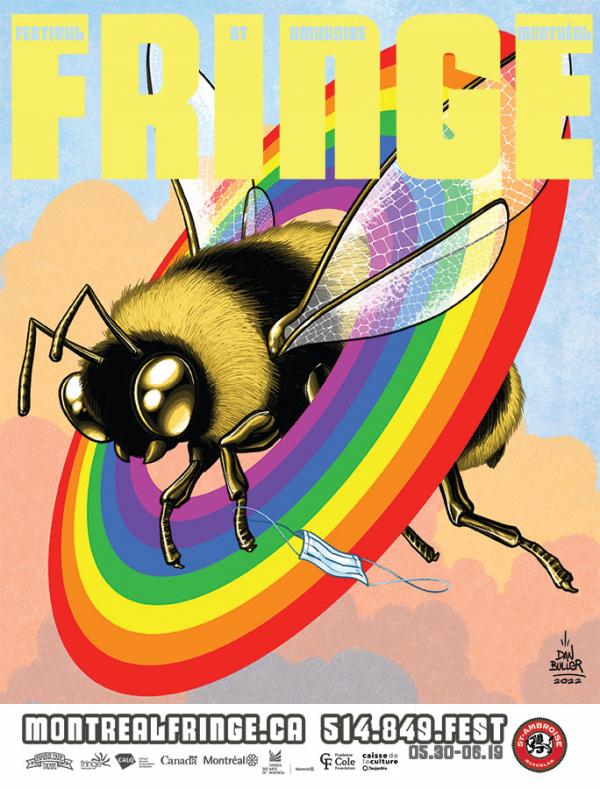
Summer in the city looks like shrubbery coming alive and green, not actually referring to the season as Spring, picking out flowers at the Jean Talon Market, bike rides along the canal, a distinct sunshine illuminating the city at golden hour when locals are seen making their way up Jeanne Mance in Docs with their totebags and picnic blankets, or perhaps more definitively: the St. Ambroise Fringe Fest painting the town in the fanciful colors of theater, dance, musicals, burlesque, storytelling, drag races, and beer for nearly three weeks.
Last night I had the pleasure of witnessing many animate souls convene under the roof of Club Soda for its annual Fringe-For-All, a night where performers have an allotted two minutes to convince the audience to see their full show before the lights dim. Fringe-For-All is a crucial night in the Fringe tradition as it sets the tone for the festival and welcomes the audience to revel in Fringe festivities. This year, the Fringe festival is in full swing, unlike last year that saw its liveliness abated by the pandemic. This time around even the drag races are back! You read that right, Fringe Park returns on the corner of St. Laurent Boulevard and Rachel Street with live music too, all free of charge.
Among the most provoking of the previews I saw were Mario a un incroyable talent, starring Hugues Sarra-Bournet who certainly does have an incredible talent, among them being the ability to bring limbo to a level of performance art. Sarra-Bournet can be discerned stupefying the audience in his clown art act in suspenders and a “696” contestant numeral on his sweater at Le Ministère from June 11th to June 19th. Tango, to the Pointe, however, garnered the rowdiest applause from the crowd among all the acts and left the audience wondering what life could’ve been had they taken up ballet as a kid-- or at least it did for me. Choreographed by Alexander Richardson and joining him with fierce pirouettes and intricate footwork contortions one would have never assumed possible, is Erin Scott-Kafadar. Their ballet-meets-tango dance tour will sweep Montreal off its feet from June 10th to the 15th at the Monument-National. Another notable ballet-related show at the same venue is The Awkward Ballerina, an autobiographical tale of playwright Kristin Govers living with cerebral palsy and the challenges and triumphs that ensue. Gover’s play is imbued with themes of acceptance and overcoming obstacles, offering an unfiltered glimpse into one’s experience living with cerebral palsy. Showings are from June 11th to the 19th. Then there's Bad Cup, a screenplay written by Catherine Cléroux and Katia Lemieux, in which an ex-mesntrual-cup-cop investigates a mischievous birth control dealer whose intentions are to control the town’s menstrual cycle. This comedy is being put on at the Mainline Theatre on select days from June 11th to the 18th. Where else would one get to see a show like this?
Supporting the Fringe Festival means supporting Montreal’s independant theater and performing arts scene and you can do so up until June 19th. The Fringe festival is a safe space for unadulterated creativity and also puts all ticket proceeds directly into the artists’ pockets. Throughout the whole duration of the show, I felt inspired and uplifted with the cliché reminder, albeit vital, to “fuck being told you can’t, [and to] fuck it if you don’t fit”, as per the words of the Fringe Festival’s Executive and Artisitic Director, Amy Blackmore, recites at the beginning of every Fringe-For-All.
Slipknot Ignite the Stage at a Nearly Sold Out Bell Centre

Metal fans were treated to quite the show this Thursday as Slipknot delivered their unhinged hits to a nearly sold out Bell Centre. The Iowa legends are supported by New Jersey’s Ho99o9 (pronounced “Horror”) and West Coast hip hop legends Cypress Hill on the 2022 Knotfest Roadshow.
The mixing of metal and hip-hop genres on this lineup made for an enjoyable and surprisingly uniting experience. While hip hop and metal fanbases tend not to overlap that much, both genres rattle with an anti-establishment energy, making for a good combo. As a result, audience members got down pretty well with Ho99o9’s punky rap-infused tracks, as well as Cypress Hill’s ‘90s beats, even though 95 per cent of attendees adorned Slipknot or other metal band tees.
Cypress Hill frontman B-Real was quick to make a connection with the audience after pulling out a 6-inch joint. “This is dedicated to all the stoners here,” he said, right before going into a medley of Cypress classics such as “I Wanna Get High,” “Dr. Greenthumb,” and “Hits from the Bong.” B-Real’s juggling of bars and tokes created heavy competition between the audience and Cypress Hill’s on-stage electronic smoke machine, even though the frontman’s own medication was most likely just a prop. The act tapered off their set with hits “How I Could Just Kill a Man,” “Insane in the Brain,” and a cover of House of Pain’s “Jump Around,” the latter two enticing an audience reaction that rivaled the crowd’s peak energy during the headlining act.
Slipknot took the stage after a brief intermission, opening with “Disasterpiece” and “Wait and Bleed,” which offered a sense of the band’s range as musicians, the first track being one of their heaviest and the second being more melodic. This opening one-two punch was emphasized by Slipknot’s impressive stage setup. Frontman Corey Taylor was flanked on both sides with ten-foot high drum risers, each home to percussionists Michael Pfaff and Shawn Crahan. These risers were attached to walkways that looped back around to an elevated rear of the stage, where the band’s sampling master Craig Jones, drummer Jay Weinberg, and turntable mixer Sid Wilson were found side by side for the majority of the set. The three other members (yes, Slipknot has nine members) in the form of bassist Alessandro Venturella and guitarists Jim Root and Mick Thomson riddled center stage as the band blasted through more heavy-hitters.
The Iowa act’s stage presence, often complemented by loud explosions and pyrotechnics, made for a visual spectacle any music fan would feel sore about missing out on. Frontman Corey Taylor also connected with the audience halfway through the set, admitting that he blew his voice out during the show prior in Albany, New York. This moment was met with an astounding applause from the arena, demonstrating a great deal of respect for the singer who was risking the tour’s remaining 14 dates to give Montrealers the show they paid for. Despite Taylor’s announcement, he powered through the band’s repertoire, giving it all during even the most brutal of screams. If he hadn’t mentioned his condition, most wouldn’t have noticed any difference.
Understandably, Slipknot’s set was still cut a little short, as they took brief intermissions between every handful of songs, presumably to give Taylor moments of rest. These intermissions amounted to about ten total minutes of the band’s set, which wasn’t really a big deal. The biggest downfall was which songs were cut, most notably the act’s staple 1999 debut opener “(sic),” which would have been a treat to see live (they played this track during the encore of previous dates on this tour).
If the 2022 Knotfest Roadshow is stopping in your city and you’re on the fence about going, take the plunge. Ho99o9 and Cypress Hill’s hip hop antics, met with Slipknot’s undeniably awe-inducing live offering make ticket prices worthwhile. Also, given that Slipknot doesn’t tour that much, fans are better off taking the opportunity while it lasts.
Hunter co-hosts The Iron Club, your weekly guide to the dark and mysterious realm of underground metal, which airs every Sunday from 9:00 - 11:00 p.m.
Pages



Staff Login | Advertise | Our Location | RSS | Contact Us
